



You’re Adding Internal Links — But Are They Actually Helping You Rank?
You probably already know that you should be adding links between your pages. You publish a new blog post, highlight a phrase, and link it back to a service page. It feels productive, like you are checking a box on an SEO to-do list. But here is a hard truth: simply adding links does not mean you have an internal linking strategy. In fact, a recent industry study found that nearly 40% of internal links point to pages that provide no SEO value, effectively wasting ranking potential.
If you are running a local service business, a healthcare clinic, or a law firm, your website is your digital storefront. When a potential client visits, they need a clear path to the answers and services they seek. Search engines need that exact same clarity. When you throw links around randomly, you confuse both your human readers and the algorithms trying to understand your expertise. Let us take a step back and look at how internal links help SEO, why your current approach might be failing, and how to fix it.
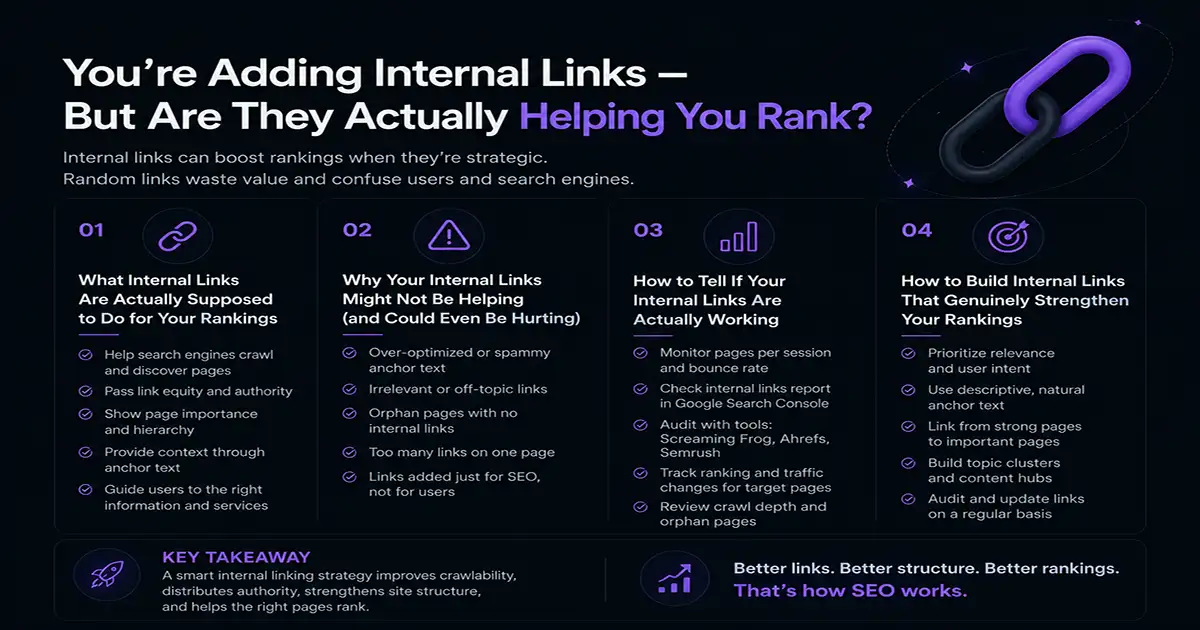
What Internal Links Are Actually Supposed to Do for Your Rankings
To understand internal linking and SEO rankings, we have to look at how search engines explore the web. Google uses automated bots, called crawlers, to navigate from one page to another by following links. According to [Google’s Search Central documentation](https://developers.google.com/search/docs/fundamentals/how-search-works), these crawlers rely heavily on internal links to discover new content and understand the structure of your site.
But internal links do more than just provide a map; they pass authority. When a high-performing page on your site links to a newer or lesser-known page, it shares some of its ranking power—often referred to as “link equity.” If you have a highly trafficked blog post about “what to do after a car accident,” linking from that post to your “personal injury lawyer” service page signals to Google that the service page is important and relevant.
Furthermore, internal links provide context through their anchor text—the clickable, highlighted words you use for the link. If your anchor text accurately describes the destination page, it gives search engines a massive clue about what that page is meant to rank for. Ultimately, internal linking for rankings is about establishing a hierarchy. It tells Google which pages are your most important, authoritative resources.
Why Your Internal Links Might Not Be Helping (and Could Even Be Hurting)
Despite knowing that internal links for SEO are important, many businesses sabotage their own efforts. One of the most common mistakes is over-optimization. This happens when you use the exact same, keyword-heavy anchor text (like “best plumber in Chicago”) every single time you link to a service page. Search engines view this unnatural repetition as spammy, and it can actually trigger algorithmic penalties rather than boosts.
Another frequent issue is the “orphan page” problem. This occurs when you publish a great piece of content but forget to link to it from your older, established pages. If a page has no internal links pointing to it, search crawlers struggle to find it, and human users will never stumble across it naturally. It effectively sits in the dark, generating zero organic visibility.
We also see businesses linking purely for the sake of linking, without considering the user’s journey. If you link a blog post about “how to fix a leaky faucet” to a page about “commercial roof installation,” the link lacks relevance. Google’s algorithms are sophisticated enough to understand context. When a link makes no logical sense to a human reader, it passes little to no SEO value. A human-first approach demands that every link you place should genuinely help the reader take their next logical step.
How to Tell If Your Internal Links Are Actually Working
So, how do you know if your SEO internal linking efforts are moving the needle? The first place to look is your website analytics. If your internal links are working, you should see an increase in pages per session and a decrease in bounce rates. This means human users are actually clicking your links and exploring your site further, which is a strong signal of content quality and relevance.
From a technical standpoint, you can use tools like Google Search Console to audit your internal links. The “Links” report within Search Console will show you exactly which pages on your site have the most internal links pointing to them. If your most linked-to pages are your privacy policy or your contact page, rather than your core service pages or pillar blog posts, your internal linking strategy is misaligned.
You should also monitor the organic rankings of the pages you are linking to. If you systematically add relevant, context-rich internal links pointing to a specific service page, you should gradually see an improvement in that page’s visibility for its target keywords. If the rankings remain stagnant after several months, it is a sign that your links might lack relevance, or that the destination page itself needs a content overhaul to meet strict YMYL (Your Money or Your Life) standards.
How to Build Internal Links That Genuinely Strengthen Your Rankings
To turn random links into a true internal linking strategy, you need to follow a few core principles. First, prioritize relevance above all else. Only link to a page if it provides additional, valuable context for the reader. If you are writing a blog post about pediatric dental care, link to your pediatric dentistry service page, not your adult cosmetic dentistry page.
Second, adopt internal linking best practices for your anchor text. Keep it natural and descriptive. Instead of using generic phrases like “click here” or “read more,” use text that tells the user exactly what to expect, such as “learn more about our pediatric dental services.” Vary your anchor text naturally; do not force the exact same keyword every time.
Finally, make it a habit to audit your older content. Every time you publish a new, important page, go back to your older, high-performing blog posts and find natural places to link to the new content. This immediately passes established authority to your new page, helping it rank faster. Remember, internal links SEO is not a one-time task; it is an ongoing process of connecting your expertise so that both users and search engines can easily find it.
If you are unsure whether your current site structure is helping or hurting your organic visibility, do not leave it to chance. Contact us for a free SEO audit today, and let us build a strategy that works.