



Ranking #1 Means Nothing If Your UX Can’t Close the Click
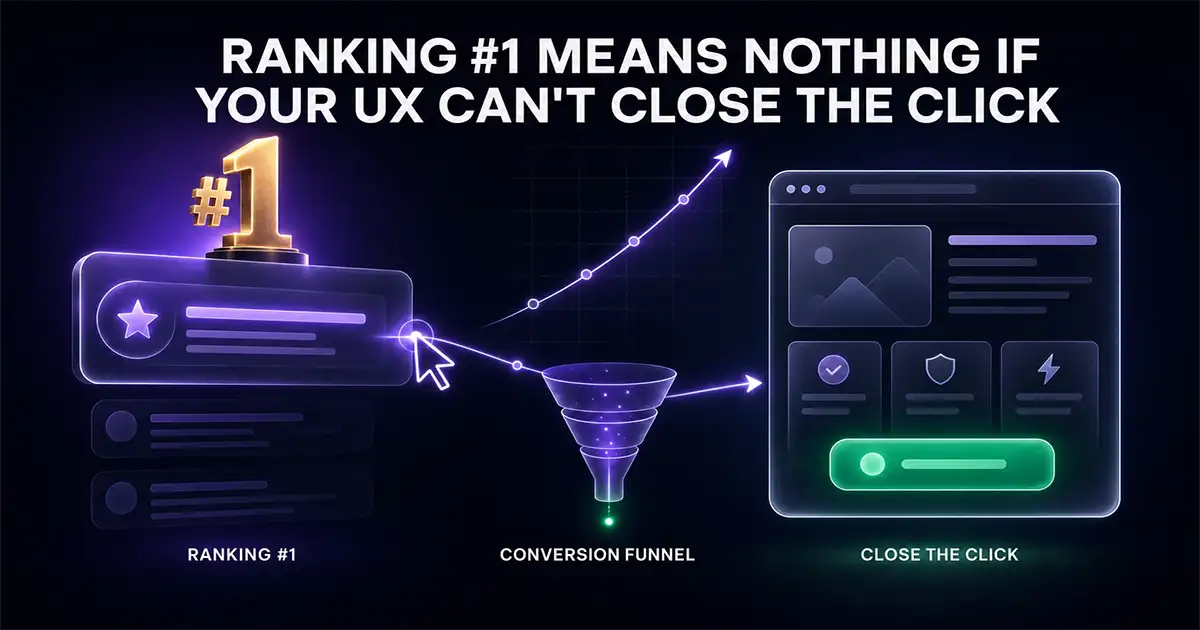
For a long time, the holy grail of digital marketing was securing the top spot on Google. We treated the number one ranking as the finish line, assuming that once we won the click, the rest would take care of itself. But in 2026, the landscape has fundamentally shifted. Recent data indicates that a staggering 68% of searches now end without a single click, thanks to the rise of AI Overviews and zero-click search features. Even when you do capture that elusive click, your organic traffic growth means very little if your website cannot guide the visitor to a meaningful action.
You might have the most brilliant SEO strategy in the world, but if your user experience (UX) is broken, your efforts are wasted. A poor experience drives away nearly 88% of visitors, and many of them will never return. As a seasoned digital marketing consultant, I see businesses pouring resources into their Google organic visibility while completely ignoring the human being on the other side of the screen. We need to shift our focus. It is time to recognize that ranking is only the introduction; your UX is what actually closes the deal.
The #1 Illusion: Why Top Rankings No Longer Guarantee Results in the Zero-Click Era
The reality of modern search is that Google is increasingly functioning as an answer engine rather than a traditional search engine. When a user types a query, they are often met with an AI-generated summary that answers their question immediately. This zero-click environment means that overall traffic volume is shrinking for many informational queries. If you are a local service provider, a small law firm, or a healthcare clinic owner, the clicks you do receive are more valuable—and more competitive—than ever before.
We often operate under the illusion that top rankings automatically equal revenue. You might hire an SEO specialist to optimize your content, build links, and secure that coveted number one position. However, if the user finally clicks through to your site only to be met with a slow, confusing, or untrustworthy interface, they will leave. This behavior, known as pogo-sticking—where a user clicks a result and immediately bounces back to the search page—sends a strong negative signal to search engines.
Google’s algorithms, particularly systems like Navboost, actively monitor these user engagement signals. If your site consistently fails to satisfy the user’s intent due to poor usability, your top ranking will not last. You must remember that while technical SEO gets you in the door, it is the human-centric experience that keeps you in the room. A freelance SEO consultant might help you win the click, but it is your responsibility to ensure the destination is worth visiting.
The Leak Between Click and Conversion: How UX Failures Quietly Undo Your SEO Wins
Imagine pouring water into a bucket that is riddled with holes. This is exactly what happens when you drive organic traffic to a website with poor UX. You might be celebrating a spike in visitors, but if your conversion rate remains flat, you have a severe leak between the click and the conversion. These UX failures are often quiet and insidious, undermining your SEO wins without triggering any obvious alarms in your analytics dashboard.
One of the most common culprits is mobile friction. In 2026, mobile-first indexing is the standard for 100% of websites. If your site looks beautiful on a desktop but forces a mobile user to pinch, zoom, or navigate tiny tap targets, you are failing your audience. A technical SEO consultant will tell you that Google measures your site’s performance based on real-world mobile data, specifically looking at Core Web Vitals like Largest Contentful Paint (LCP) and Interaction to Next Paint (INP).
Another massive leak is a lack of immediate trust signals. Users form an impression of your website within 50 milliseconds. If they encounter an outdated design, aggressive pop-ups, or a lack of clear contact information, they will doubt your credibility. For businesses dealing with Your Money or Your Life (YMYL) topics—such as law or healthcare—this trust is non-negotiable. If you employ spammy tactics or hide your value proposition behind a wall of text, the user will simply hit the back button and choose your competitor.
Closing the Click: The Usability Fixes That Turn Visitors Into Action
To stop the leak and start converting, you must prioritize usability fixes that turn passive visitors into active leads. This requires a shift in mindset: stop optimizing solely for the algorithm and start designing for the doubtful, impatient human. Every element on your page should serve to reduce friction and build confidence.
Start by addressing your site’s speed and responsiveness. Ensure that your images are optimized, render-blocking scripts are deferred, and your mobile experience is flawless. When a user taps a button or opens a menu, the response must be instantaneous. An INP score over 500 milliseconds feels broken to a user, and fixing this lag is a critical step in your overall technical SEO strategy.
Next, focus on the clarity and structure of your content. Users do not read websites; they scan them. Adopt an “answer-first” approach where the most important information is presented immediately, followed by logically organized details.
•Use clear, descriptive headings to guide the eye.
•Break up dense text with relevant images or tables.
•Ensure your contact information and primary call-to-action (CTA) are always visible.
By removing the cognitive load required to navigate your site, you make it incredibly easy for the user to take the next step. Transparency and relevance must be at the core of your design.
From Ranking to Revenue: Building a UX That Makes Your #1 Spot Finally Pay Off
Ultimately, the goal of any SEO strategy is not just to generate traffic, but to generate revenue. To bridge the gap between ranking and revenue, you need to build a UX ecosystem that actively supports the user’s journey. This means aligning your organic visibility efforts with a deep understanding of your customer’s needs, anxieties, and motivations.
When an SEO consultant helps you achieve a top ranking, that is just the beginning of the partnership between your website and your prospective client. You must deliver an experience that matches the promise of your search snippet. If a user clicks a link expecting a seamless booking process for a consultation, the form should be simple, secure, and function perfectly on any device.
We must always remember the human-first principle. Search engines will continue to evolve, and AI will continue to change how users find information. However, as Google’s own guidance on people-first content makes clear, the fundamental desire for a fast, clear, and trustworthy online experience will never change. By integrating robust UX principles with your technical SEO foundation, you ensure that your number one ranking is not just a vanity metric, but a reliable engine for sustainable business growth.
Ready to turn your traffic into tangible results? [Use our CTA in main website] to schedule a comprehensive UX and SEO audit today, and let us help you close the click.